

Project Overview
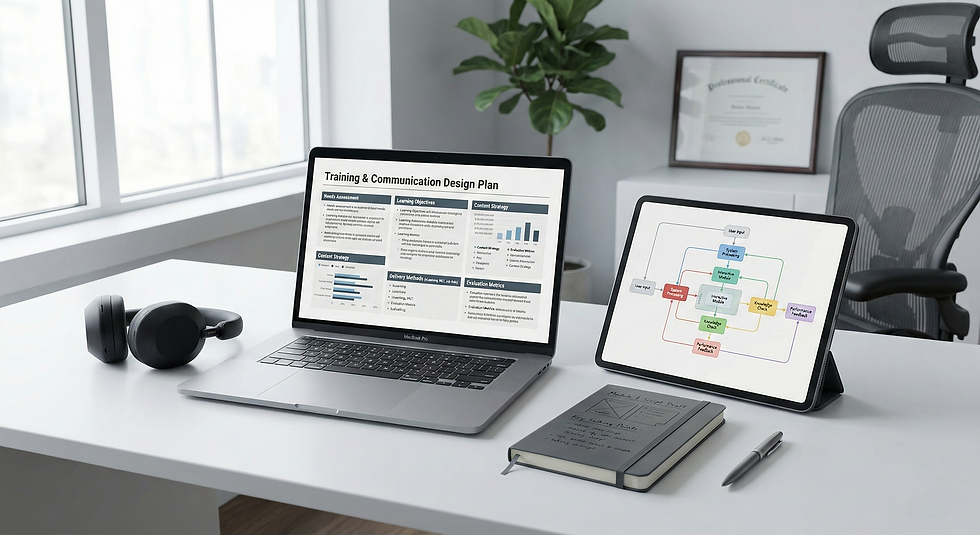
Training & Communication Design Plan for System Transformation
Organizations going live with a new enterprise system face more than a technical upgrade—they face changes to workflows, roles, and confidence. This project shows how I designed an end‑to‑end training and communication approach to help employees adopt “System B” with clarity and support.
The organization was moving from fragmented legacy tools to a unified platform and needed employees to learn new navigation, terminology, and workflows without disrupting daily operations. My goal was to equip staff and leaders with the skills, messages, and resources required to use System B effectively and sustain new ways of working.
In this project I acted as Instructional Designer, Training & Communication Specialist, and Change Management Consultant. I analysed change impacts, translated complex system updates into simple messages, designed role‑based training, and created communication assets and job aids to guide employees before, during, and after go‑live.
This flagship case study illustrates how I integrate learning design, communication strategy, and change enablement into one cohesive solution for system transformation.
In addition to formal training, the solution is designed as an enablement program that removes friction in the flow of work through job aids, communications, and just‑in‑time support.
Role: Austine Mattatall – Learning Experience Designer, Training & Communication Strategist, Change Management Consultant (MILS)
Business Problem & Training Strategy
The legacy landscape created data fragmentation, manual workflows, and limited scalability; System B offered a unified, analytics‑driven platform, but only if employees could adopt new ways of working quickly and confidently.
I owned the end‑to‑end training strategy, from needs analysis and curriculum architecture to delivery model and evaluation approach.


Stakeholder Map (Who This Affects)
-
All Employees: Need clear, role‑relevant guidance on new navigation, terminology, and daily workflows in System B.
-
Department Leads: Need analytics and reporting skills to use System B for oversight, planning, and performance conversations.
-
Project Teams: Need collaborative workspace skills to manage tasks, communication, and progress inside the new platform.
-
Support & Help‑Desk Teams: Need deeper system knowledge and workflows to resolve issues quickly and coach users.

Impact & Metrics (Target Outcomes)
This training and communication plan was designed to drive measurable system adoption, not just attendance; the success measures for System B set the following target outcomes:
-
Training participation: 95% of impacted employees completing their assigned learning.
-
Readiness score: average 4.25/5 self‑reported confidence with key System B tasks.
-
Performance: 40% faster task completion and 25% fewer errors compared to the legacy system.
-
Support load: 60% reduction in support tickets by Week 4 after go‑live.
These metrics show how the solution connects learning design, communication, and change management to business outcomes.
These metrics would be tracked using a combination of LMS reports, post‑training surveys, time‑to‑competency assessments, and help‑desk ticket analysis.
Evaluation Approach
The enablement program is evaluated using a balanced approach: behaviour and proficiency measures for employees, operational indicators like ticket volume and cycle time, and business outcomes linked to productivity and risk reduction.

Implementation Realities & Design Principles
1.
2.
3.
Reality
Response
Design principle
Tight timelines and evolving system requirements created ambiguity around training scope.
Leadership teams held different assumptions about who owned change reinforcement.
Employees had to replace familiar tools with new workflows while still working in live operational conditions.
Prioritised critical workflows, designed modular learning assets, and aligned communications with the phased rollout plan.
Structure training and communications in modular, task-based units so scope can flex without losing clarity or adoption.
Facilitated focused readiness conversations and clarified responsibilities across leaders, managers, HR, and support teams.
Make ownership and reinforcement roles explicit early to reduce escalation and decision friction during rollout.
Introduced scenario-based walkthroughs, simple job aids, and just-in-time performance support aligned to real tasks.
Pair realistic practice with concrete performance support to accelerate confidence and behavioural adoption at go-live.

System B Transition Journey (Infographic)
This infographic gives stakeholders a quick view of the overall system transition and training journey.

This artefact is intended for executive and manager briefings, helping leaders communicate the transformation story consistently across teams.

Job Aid: 5 Steps to Navigate the New System
This quick reference guide helps employees complete core tasks in System B at the point of need.

The job aid is designed to reduce early‑stage support tickets and errors by giving employees an at‑a‑glance guide for their most common workflows.

Change & Communication Strategy
Change & Communication Toolkit
To support adoption of System B, I designed a suite of communication assets that guide employees and leaders through the transition. These materials build awareness, reduce anxiety, and ensure that everyone knows what is changing, why it matters, and how to get support.System-Transformation_Communication-Deliverables-Pack.pdf
The toolkit includes:
-
Training announcement and readiness messages that introduce the change, explain expectations, and prepare employees before training begins.
-
“What’s Changing?” overview and FAQ sheet that summarise key impacts and answer common questions from different stakeholder groups.
-
Help‑desk and support guidance that directs employees to office hours, team champions, and self‑service resources during and after go‑live.
These deliverables demonstrate how I combine communication design and change enablement with instructional design to drive smoother system adoption.
The communication plan is sequenced to build awareness, readiness, and commitment over time, aligning with change‑management principles such as staged messaging, visible sponsorship, and feedback‑driven adjustment.

Micro-Explainer: What’s Changing?
This micro-explainer introduces employees to the upcoming digital system transformation. Its purpose is to deliver the essential “what, why, and who” of the change in a short, engaging, and reassuring format. The video sets the tone for the transformation by providing early clarity and reducing uncertainty before formal training begins.
My Role & Contribution
-
Defined the change messages employees needed first
-
Translated complex system updates into clear, human-centered language
-
Designed the information flow and message hierarchy
-
Created the storyboard and visual direction for the micro-explainer
-
Ensured alignment with MILS branding and transformation communication standards


Why This Video Matters
This micro‑explainer introduces employees to the upcoming system transformation in a short, reassuring format that answers the essential “what, why, and when.” It demonstrates how I use storyboarding, plain‑language scripting, and branded visuals to reduce uncertainty, build early buy‑in, and prepare employees for formal training.
The explainer sits at the top of the communication funnel, reinforcing key messages from the training plan and communication pack and preparing employees to get more value from subsequent touchpoints.
Communication Deliverables Pack (PDF)
A suite of strategically crafted communication assets designed to guide employees through the transition to System B with clarity and confidence.
This pack includes targeted announcements, readiness messaging, employee overviews, FAQs, and step-by-step transition guidance—ensuring consistent, human-centered communication across the entire change journey.
All templates are designed to be customised and approved by the transformation office and executive sponsors, ensuring message alignment and credibility.
Implementation Tools & Capabilities
Tools Used
-
Microsoft PowerPoint (Advanced): Structuring the communication pack, creating enterprise‑style slides, and building transformation‑focused layouts.
-
Gamma: Generating polished, consulting‑grade presentation cards and enhancing visual storytelling.
-
Canva: Branded visual design, mockups, icons, and MILS‑aligned graphics.
-
Adobe Acrobat: Professional PDF refinement, page numbering, and final polish for stakeholder‑ready documents.
-
Articulate Rise 360 / Storyline: Structuring modular learning flow and preparing learner‑friendly content frameworks.
-
Clipchamp (or similar editor): Micro‑explainer video refinement and light editing.
-
Wix: Portfolio design and integrated presentation of deliverables.

Skills Demonstrated
-
Instructional design strategy that balances human‑centred experience with enterprise goals.
-
Training needs analysis, audience profiling, and workflow mapping for a system transformation.
-
Communication planning, messaging architecture, and stakeholder enablement for change initiatives.
-
Microlearning, video‑based instruction, visual storyboarding, and job aid development.
-
Data‑informed design decisions and evaluation readiness using adoption, proficiency, and support metrics.
-
Stakeholder alignment and leadership partnering to secure sponsorship and decision-making for change initiatives.
-
Cross-functional collaboration with project teams, SMEs, HR, and support functions to integrate training, communications, and change activities.
